
Our First Student Siddik
SAMRIDDHI LEARNING CENTRE
Don’t Let Another Siddik Slip Away: Support Samriddhi’s Dream
The year was 2008. In the nascent days of Samriddhi Learning Centre for Underprivileged Children, a small initiative brimming with hope in the heart of Vaishali, Ghaziabad, fate played a gentle hand. A young boy named Siddik became its destiny’s first mark, officially enrolled as Roll Number 1, Batch 2008. He wasn’t just a number; he was the seed from which a larger dream would sprout.
Ms. Nipra Mazumdar, the driving force behind Samriddhi, first encountered Siddik outside the familiar walls of her residential society. Even then, his story was etched in his young features. Identified early on with a vision deficiency that had progressed to medical blindness, Siddik navigated a world shrouded in shadows. Yet, within him burned a fierce inner light, an unwavering self-esteem that refused to succumb to the fate of dependence. He harbored no desire to join the ranks of beggars, a common sight in his periphery.
Siddik’s young life had already known loss. His father had passed away when he was a mere three years old, leaving him in the care of his uncle’s family. Their modest existence was a constant struggle. His uncle toiled as a car cleaner in the early hours, his mornings giving way to arduous days ferrying passengers on his cycle rickshaw until dusk painted the sky.
Siddik, often left to his own devices, would wander near Ms. Nipra’s society. It was there, amidst the manicured lawns and bustling activity, that he would sometimes encounter her kind face and receive a biscuit or a small snack. These fleeting moments of respite offered temporary relief from hunger, but Ms. Nipra’s vision extended beyond immediate needs. She understood that true empowerment lay not in fleeting charity, but in providing the tools for self-sufficiency.
One day, she knelt down, her voice gentle yet direct, and asked him a simple question that held the weight of a potential future: “Do you want to study?” Siddik’s response was immediate, his voice filled with an unexpected enthusiasm, a spark ignited in his shadowed world. It wasn’t just about the promise of learning; it was, perhaps in his young mind, the promise of a “full day meal for an entire life”– a security he had never truly known.
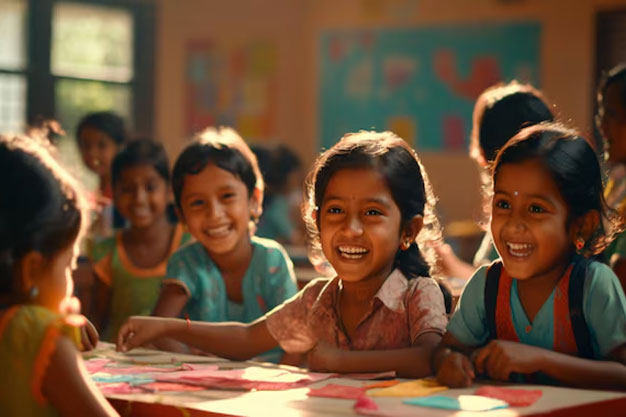
And so began Siddik’s journey into the world of letters and numbers. His first lessons were intimate, shared with Ms. Nipra– the taste of home-cooked food mingling with the sounds of alphabets and the rhythm of counting. A new world was unfolding for him. He eagerly anticipated reaching the shade of the old tree, a makeshift classroom where a few other children, their faces mirroring his own blend of vulnerability and hope, would gather for this nascent school.
Those tiny faces, the pioneers of Samriddhi Learning Centre’s first batch, shared a simple yet profound motivation: to follow the mysterious shapes of alphabets and the logic of numbers, and in doing so, earn a nourishing meal that sustained both body and spirit.
But the world, as it often does, brought its unpredictable currents. Siddik’s stay with his uncle’s family, his anchor in a turbulent life, was disrupted by unforeseen circumstances. Perhaps his uncle had to relocate for work, or perhaps other family dynamics shifted. Siddik, who had found a sense of belonging and purpose near the fledgling school, yearned to remain close to this newfound haven. But their plans diverged from his silent wish. And so, Roll Number 1, Batch 2008, Siddik, vanished from their daily sight. Seventeen years have passed since that time, and the founders of Samriddhi still hold a quiet hope, a lingering question in their hearts: what became of the boy who was their first student? What journey did destiny chart for him after those initial six months of learning?
There was a moment etched in Ms. Nipra’s memory, a testament to the deep connection forged in those early days. Siddik had fallen gravely ill. Driven by concern, Ms. Nipra ventured into the unfamiliar lanes of his slum dwelling. She found him feverish and frail. As she gently placed her hand on his forehead, a familiar touch in his often-unfamiliar world, his eyes, though clouded by illness, widened in recognition. A wave of pure, unadulterated happiness washed over his small face. It was as if a dream had momentarily materialized. He made a fervent promise to return to school soon, his voice weak but resolute. And he did. For a brief period, the familiar figure of Roll Number 1 was back under the shade of the tree. But fate, it seemed, had already drafted another route for his young life.
The story of Siddik is not a singular tragedy; it is a microcosm of a larger reality. There are countless “Siddiks” living in the shadows of our comfortable lives, their presence often unnoticed, their potential untapped. The narrative poses a poignant question: how many among us truly see them?
The call to action is clear and personal. It begins not with grand gestures, but with the simple act of extending a hand to someone we know, someone whose circumstances might be similar to Siddik’s. The belief is that if each individual takes responsibility for the well-being of those within their immediate sphere, then the dream of “Samriddhi”– a state of flourishing and opportunity– can become a reality for every child like him.
The message resonates with a powerful truth: genuine change begins with intention, and where there is intent, pathways to fulfilment will inevitably emerge. The essence of humanity lies in the breadth of our compassion, in the willingness to open our hearts to the needs of others. The final words offer a simple yet profound philosophy: by creating small acts of kindness, by bringing a smile to the face of someone we know, we set in motion a ripple effect, trusting that the universe, in its own mysterious ways, will respond. Siddik, Roll Number 1, Batch 2008, may be lost to their immediate sight, but his story remains a potent reminder of the countless lives waiting for a chance, a hand to guide them towards their own “Samriddhi.”

All Categories
Recent Posts
PRAGATI : A Social Initiative for Empowering women

Our First Student Siddik